

 Bahasa Indonesia
 العربية
 中文
 한국어
 日本語
Four ways to process coffee: natural, washed, wet-hulled, honey
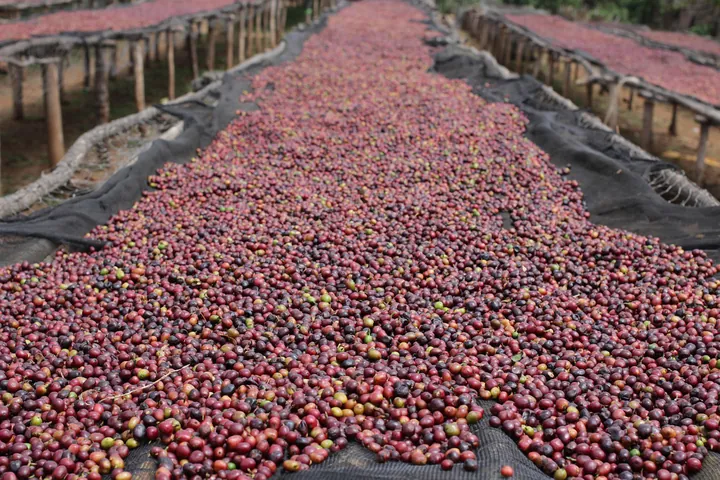
On a green coffee quotation, the process is often reduced to a single word: natural, washed, wet-hulled or honey. For a buyer that word decides two things at once — the flavour profile that will come out of your roaster, and how much quality risk travels with the lot from farm to your warehouse. This is what each process actually means, with figures you can check for yourself.
The starting point is the same: a fruit, not a bean
Coffee cherries ripen about eight months after the plant flowers, then are harvested by hand or by machine. In Indonesia, all arabica is picked by hand, whether grown by smallholders or on medium-sized estates. After harvest, every process begins with the same job: separate the fruit layers from the bean, then dry the bean until it is stable enough to store and ship. What differs is the order of those steps and how much fruit is left on the bean while it dries. That difference is what changes the cup.
Natural: the whole cherry is dried
In the dry or natural process, the whole cherry is dried. It is the oldest of the traditional processing methods. The bean dries inside its fruit, and some of that fruit character carries into the cup. Sun-drying takes several days; machine drying takes a few hours.
For buyers, the practical consequence is dependence on weather and on discipline. Because the entire fruit sits against the bean during drying, one natural lot dried unevenly shows flavour defects more readily than a washed lot does.
Washed: fruit removed before drying
In the wet process, the fruit covering the bean is removed before drying. The result is called washed coffee.
Washed coffee is often associated with high quality, but it demands skill and a lot of water. Conventional wet processing may consume 20 to 100 cubic metres of water per tonne of green coffee, and the lower end of that range is reached only where water is recycled. For buyers who assess supplier sustainability, this is a fair question to ask: how much water is used, and how is it treated afterwards?
Wet-hulled (giling basah): the Indonesian method
Indonesia has its own variant, wet-hulled or giling basah, also called semi wash. The difference from a full wash is timing: the parchment is hulled while the bean is still wet, not after drying. The method is common in Indonesia and leaves a distinct signature in the cup.
The production context matters. More than 90 per cent of Indonesia's coffee is grown by smallholders on farms averaging around one hectare, and the sector is dominated by an estimated two million smallholders spread across often remote villages. Consistency therefore depends heavily on post-harvest support, not on variety alone.
A concrete example of how process shapes flavour comes from Gayo. Because of giling basah processing, Gayo coffee is described as higher toned and lighter bodied than Lintong and Mandheling coffees from further east in Sumatra.
Honey: mucilage left on the bean
The honey or pulped natural process removes the skin and pulp but leaves the mucilage on the bean during drying.
The numbers to check in your contract
Whatever the process, one number still governs everything: the bean has to be dry. Wet-processed coffee must be dried to 10–12 per cent moisture to be stable. Our own specification is tighter at the top end: green coffee is graded under SNI 01-2907-2008 with moisture max. 12.5 per cent, foreign matter max. 0.5 per cent, and Grade 1 at a defect value of max. 11 per 300 g. We confirm those values for every lot before contract, not once for all shipments.
Questions worth putting to any supplier:
- Which process was used for this lot, and is it the same for the whole volume I am buying?
- What are the moisture and defect values, measured when, and by whom?
- For natural and honey lots: how is drying handled when it rains?
- For washed lots: what is the water use, and how is the wastewater managed?
What it means for buyers
A process name is not a quality guarantee, but it tells you which risk you are buying. Natural and honey lots lean harder on weather and on drying discipline. Washed lots cost more in water and skill but are easier to keep consistent. Wet-hulled coffee delivers a distinctly Indonesian character, provided post-harvest handling is well supervised.
In practice: decide the cup profile you want first, then choose the process. For blends that need body, robusta and commercial arabica make more sense; for a single-origin menu, Grade 1 arabica with a clearly stated process per lot is the better fit. If you want to compare before committing to a container, we can send a 350 g sample with the lot specification. How grades and defect values are counted is explained in our Indonesian coffee grade guide, and current availability by process is on the Arabica green bean page.
Send your requirement — process, volume and destination port — to [email protected] or WhatsApp +62 856-5928-9694. We reply with the lot specification, not an estimate.
Sources
- Coffee production · Wikipedia
- Coffee production in Indonesia · Wikipedia
- Panduan grade kopi Indonesia (SNI 01-2907-2008) · Rasa Nativa Java
Baca artikel ini dalam Bahasa Indonesia
Looking for West Java coffee or tea?
We supply green coffee beans and tea from 1 kg to full export containers. Ask for a sample or a price quote.