

 Bahasa Indonesia
 العربية
 中文
 한국어
 日本語
Rasa Nativa Java: preparing exports as coffee returns to surplus
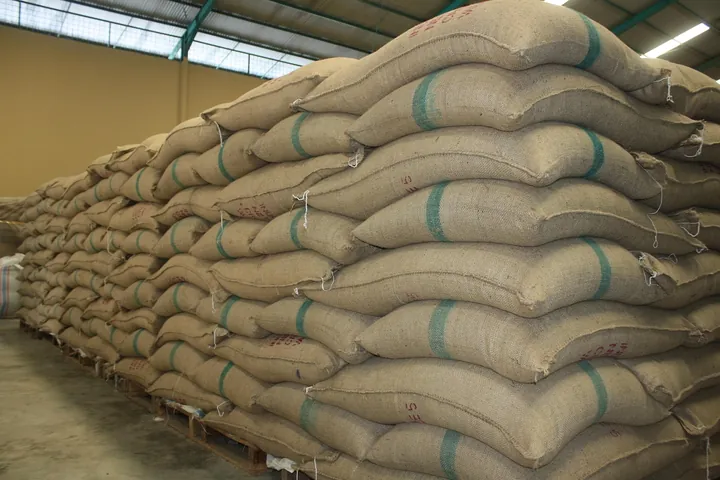
The International Coffee Organization's monthly report, released on 10 November 2026, carries news the market has not seen for years: world coffee production hit a record 183.6 million bags in coffee year 2025/26, up 4.4%, while consumption slipped 0.9% to 180.6 million bags. The result is a surplus of 3 million bags — the first since 2020/21.
For buyers, a global surplus does not automatically mean cheap coffee, and it certainly does not mean Indonesian supply has loosened. The two are moving in opposite directions, which matters when you plan 2027 purchases.
A global surplus, a smaller Indonesian crop
The USDA Foreign Agricultural Service forecasts Indonesia's green coffee production falling 8% to 11.38 million 60 kg bags in 2026/27: 10 million bags of robusta and 1.38 million of arabica. Exports are forecast 11% lower at 7 million bags, while domestic consumption edges up to 4.83 million bags. The cause is excessive rain during flowering and fruit development in the robusta areas of southern Sumatra and Java.
The ICO data points the same way. Indonesian shipments fell 14.9% to 8.69 million bags in 2025/26, even as exports from Asia and Oceania rose 12.8%.
In plain terms: the world has plenty of coffee, Indonesia has less. For buyers who need Java arabica or West Java robusta at a fixed specification, lot certainty and shipping schedules matter more than waiting for the index to fall.
A wild week on the screen, a calmer physical market
8–14 November 2026 showed how noisy futures can be. ICE December arabica touched a six-week low of 262.15 cents/lb on Wednesday, then jumped 4.16% on Thursday to 280.20, closing the week near 273.94 cents/lb — down 2.16%. ICE January robusta settled at USD 3,207 per tonne, down 1.93% and close to a two-and-a-half-year low.
Meanwhile the ICO's physical indicators moved the other way: the composite edged up 0.54% to 249.09 cents/lb over the same week. The monthly average of the ICO Composite Indicator Price eased less than 1% to 261.26 cents, while the robusta indicator lost 2% to 164.19 cents.
That divergence is normal — physical indices move more slowly than futures. For buyers, though, daily swings like these are a reason to agree specification and volume first, rather than chasing a single price point.
What we prepared this week
On our side, we published two supporting articles on the website: a buyer's guide to EUDR readiness, and an explanation of the two figures that most often decide the outcome of sorting — 12.5% moisture and defect value. We also published our Indonesian coffee grade guide in English for overseas buyers.
For every lot we confirm moisture max. 12.5%, foreign matter max. 0.5%, and a defect value of max. 11 per 300 g for Arabica Grade 1 under SNI 01-2907-2008, screen 15–19, in 60 kg jute bags (HS 0901.11). Green tea follows SNI 3945:2016 (moisture max. 8%; HS 0902.20) and black tea SNI 1902:2016 (max. 7%; HS 0902.40), packed in 25 or 40 kg paper sacks.
Export documents — commercial invoice, packing list, PEB export declaration, bill of lading, ICO certificate of origin, and phytosanitary certificate on request — are prepared per shipment, on FOB or CIF terms per contract. Orders run from 1 kg for cafés and small roasteries, to one sack for wholesale, to full 20 or 40 ft containers for importers.
What it means for buyers
- Buy on lot specification, not only on the index. Moisture, defect value, screen and crop year set the real cost after roasting; the index is only where the conversation starts.
- Agree volume and timing early. When Indonesian supply tightens, lots with a consistent profile move faster than the global headline balance suggests.
- Request a sample before contracting. For new buyers, a 350 g sample ships against a USD 100 deposit (export) or IDR 150,000 (domestic), credited against the first order — details in our sample policy.
- Check documents from the start. For markets that require due diligence, document readiness decides how smoothly a container sails, not the price.
We do not quote a price in this article: offers are prepared per product, grade and volume. To start, request lot specifications or a sample at [email protected] or WhatsApp +62 856-5928-9694.
Sources
- ICO report: World coffee exports up 1% to 142.4m bags in 2025/26 · Comunicaffe (mengutip laporan bulanan International Coffee Organization, 10 November 2026)
- Coffee this week: arabica round-trips to flat as ICE stocks build · World Coffee Index, 14 November 2026
- Indonesia Coffee Report: Production Predicted to Drop 8% in 2026/27 · Daily Coffee News (mengutip USDA Foreign Agricultural Service, 26 Mei 2026)
Baca artikel ini dalam Bahasa Indonesia
Looking for West Java coffee or tea?
We supply green coffee beans and tea from 1 kg to full export containers. Ask for a sample or a price quote.